

The star has handed over the entirety of his twenty-five thousand pound Mercury Prize cash to the trust for venues, which functions to preserve the Britain's independent music venues.
Fender was awarded the cheque on mid-October as his latest record People Watching was named the outstanding release of the last 12 months.
The musician has opted to give the cash to the Music Venues Trust, in appreciation of the essential function small stages played in his early career.
"As an artist wouldn't be doing what I am doing today if it hadn't been for all the gigs I performed around the region, and elsewhere, when I was starting out," remarked Fender. "These spaces are legendary, but they are facing challenges."
Beginning in 2023, at least 150 of these venues have permanently closed – roughly one-sixth of the entire UK sector.
Recently, major artists like Pulp, Coldplay, the singer Katy Perry and Ed Sheeran have all aided the MVT in its efforts to support the industry, by applying a small levy to their ticket costs, which supports smaller concert halls.
Sam Fender also took part, raising over £100k on his live tour to help numerous grassroots venues across Britain.
The donation supported venues that were facing imminent closure due to difficulties arising from flooding, fire incidents and family tragedies, as well as permit problems, legal disputes and noise complaints.
Some locations obtained financial assistance in modernizing facilities and sound and lighting systems that helped artists and audiences.
"The idea that money from performances in major spaces helps the smaller venues, where it kicks off for performers like me, is just common sense," the star has said.
The musician is among several artists to contribute his award funds to worthy causes.
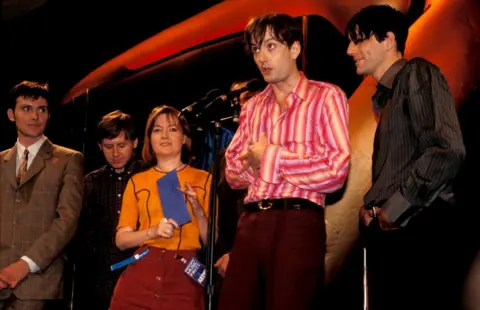
When Pulp received the trophy in 1996 for their release Different Class, lead singer Cocker stated that the act would contribute their winnings to the organization War Child.
During 2002, artist she split her prize between several organizations, like the children's charity and a charity for Sickle Cell.
"Additionally, I gave a thousand pounds to my local community centre, to their classes, because I did gymnastics when I was a child and they needed better apparatus," the artist told a publication.
Two years ago, they contributed their funds to the community center that supported their group, in addition to other grassroots music organisations.
And 1994 winners they contributed their prize to a charity for MS after a friend was found to have the condition.
"Receiving the award was quite enough," said singer Small. "The prize was the extra but we didn't require the bonus, because we had the honor. So our winning touched the lives of others."
In the past week, the trust shared it had protected a couple of small stages in south-east England, by bringing them into community ownership.
The first in Southampton and the second in the city were acquired under the public acquisition program, which is funded by the arts council and music fans who buy "ownership units" in the buildings.


